Sunday, May 5, 2013

Ordinary Grace by William Kent Krueger

In Ordinary Grace, Frank Drum's world is rocked when tragedy descends upon small town New Bremen, Minnesota, in 1961. His teenaged worries seem small compared to the bigger issues he now faces. The secrets, lies and betrayal that are uncovered force him to grow up and face decisions that will test his nerve.

I love this book! The whole mood and setting of the book was terrific. It sort of reminded me of the TV show The Waltons with the character and his casual narration looking back on his teenage years in simpler times. There are many tragedies that descend upon this family and small town, but the action isn't graphic or gratuitous. The unrest that is normally associated with that 1960s decade either hasn't started yet or hasn't made it yet to this small town.

Frank Drum is a wonderful narrator. I loved that the story was told from his point of with him looking back on his life when he was a teenager. It really felt like he was sitting in front of me relating the story. He wasn't filled with angst and didn't make rash decisions that I often associate with teenagers. He was mild-mannered...more like Jim-Bob Walton and less like Holden Caulfield in Catcher in the Rye. I think some of the wisest statements I've heard came from the youngest Jake, near the end of the book. He really got to me in the end. Who would have thought someone so young and quiet would turn out to be filled with wisdom?

The other main characters in the book were varied and a little eccentric. I loved that they weren't stereotypical or syrupy. They were: Frank's Methodist minister father, who's haunted by the war; Frank's artistic mother, who doesn't exactly act like a minister's wife; his older sister Ariel, who's off to Julliard; and his younger brother Jake, who seems to grow up before our eyes. There were also some peripheral characters who stood out for me: Lise and Emil Brandt as well as Karl.

I often wonder how an author picks which character is going to tell the story, especially when the protagonist or narrator is a child or in this case a teenager. It definitely would have been a whole different story had it been told from another character.

I also liked that the story took place not too far from here, Minnesota. It's not quite my backyard, but at least it's a state that I've been to that isn't too different from where I live.

New word: surcease (page 71): cessation or stoppage

I adore the following quotes. They made me love the book more and will definitely be added to my list of all-time favourites. I'm amazed that I found three I love from just one book.
Loss, once it's become a certainty, is like a rock you hold in your hand. It has weight and dimension and texture. It's solid and can be assessed and dealt with. You can use it to beat yourself or you can throw it away. (page 175)
...there is no such thing as a true event. We know dates and times and locations and participants but accounts of what happened depend upon the perspective from which the event is viewed. (page 306)
The dead are never far from us. They're in our hearts and on our minds and in the end all that separates us from them is a single breath, one final puff of air. (page 307)
This is the first book I've read by this author. He also writes a mystery series featuring Cork O'Connor, but haven't read any of them. This book is a standalone and is not part of that series. There's a mystery element to the story, but it's not strictly a mystery.

Highly recommended. I hope he writes another standalone book like this one.

For more information about this book, please visit Simon & Schuster's website.

For information about the author and his other books, please visit William Kent Krueger's website.

I'd like to thank those nice people at Simon & Schuster for this review copy.

Ordinary Grace by William Kent Krueger, Atria Paperback (Simon & Schuster) ©2013. ISBN 9781476740126(Trade paperback), 307p.

Saturday, May 4, 2013

The Banks of Certain Rivers by Jon Harrison

In The Banks of Certain Rivers, Neil Kazenzakis is struggling to put his life back together after a tragic accident has left his wife in a permanent state of comatose. Besides teaching and coaching, he's been raising his now teenage son on his own, while trying to keep a romantic relationship with his mother-in-law's private nurse a secret from everyone. Things are running smoothly, until a series of misfortunes threatens to derail his progress and set him back. First, a video surfaces showing Neil in a scuffle with one of the students, then he starts receiving harassing phone calls and emails. If that wasn't bad enough, his son finds about his affair and doesn't take it well.

Overall, I really enjoyed this book. The story was interesting, current and relevant. It's hard to believe that this is Harrison's debut novel. It was really well done. While I liked the whole story, I was especially touched by the ending. By then, I had connected with all of the characters and really wanted to see how things worked out for them.

Neil was a sympathetic and likeable character. He's far from perfect, but his particular transgressions made him all the more human to me. I really wanted things to turn out for him. I really liked Christopher, too, who was a pretty good kid when it came right down to it. Lauren rubbed me the wrong way in the beginning. Her first "romantic encounter" with Neil in the book felt a little gratuitous. However, as the story went on, she grew on me and by the end, I liked her as much as I liked Neil.

I loved the series of emails Neil sent to his wife, even though he knew she couldn't read them. It was therapeutic for him and a wonderful way for the author to add details to the story. I was a little sad that they ended a bit abruptly and that the author didn't make use of them throughout the whole story.

I don't want to give too much away about the video, but I will say it was really scary how quickly things got out of hand with it. Neil was lucky to have good people on his side.

New word:
détente (page 233): easing of hostility

I really liked the title and the cover of this book. It would definitely draw me in and make me want to pick up the book (if it were in a bookstore) or investigate it further (online). However, I'm not sure what it had to do with the overall story. If there was a reference or explanation somewhere in the story, I'm sorry I missed it.

There were a few bumps in the story, but those were relatively minor and didn't at all detract from my enjoyment of the story. Highly recommended. I'd definitely read another book by this author.

For more information about this book, please visit, The Banks of Certain Rivers website.

I received this electronic copy for review.

The Banks of Certain Rivers by Jon Harrison, ©2013. ASIN B00BXKY6VA(eBook), 319p.

Thursday, May 2, 2013

Fooling Houdini by Alex Stone

In Fooling Houdini, Alex Stone relates his story of how he became a master magician. His story goes beyond the training and hard work, though. He has done lots of research into the brain allowing the reader to see how magic and perception work with human nature.

I loved this book!! The whole thing is absolutely fascinating and so well written. When I pulled this off my shelf to read, I remembered that Mark from HarperCollins had recommended it, but I hadn't remembered that it was a memoir. I wasn't sure I was going to like it or if I was in the mood for a memoir. I shouldn't have worried at all. It really was fantastic.

I loved that Stone delved into so much more than magic. His offered insight into the human brain and how it works with our eyes and hands. To become a magician, he not only attended several magic camps, workshops and seminars to learn about magic, but he also visited psychology labs, Las Vegas casinos and the streets of New York for 3 card Monte games in an effort to understand magic and illusions better.

Richard Turner's story was both amazing and inspiring. He's a blind magician who has absolutely mastered playing card manipulation. Through his story, Stone explains more about the brain, the fingers and how the blind see with their fingers. Amazing!

It shouldn't surprise anyone that magicians who do card tricks or close-up magic need strong, flexible hands. Stone briefly takes the reader through his Finger Fitness (page 91-93) routine, which is essentially calisthenics for the hands. These exercises are not just for magicians. They are for anyone who does a lot of stuff with their hands or for those who've experienced pain in the wrists and hands. I fall into both categories: I type, craft and play the flute and have suffered from some arthritis and repetitive stress pain in my hands. I'll definitely be looking into this fitness routine further.

In one part, Stone relays his disdain for mentalists, whom he calls dishonest liars. He explains how they do what they do, from mind reading to spoon bending, and how easy is for some of us to believe them. This has never been my favourite type of magic, but Stone's explanations were insightful and interesting.

One of my favourite parts of the book was the examination of the 3-card Monte games on the streets of New York. He describes them as a well-choreographed play with numerous "actors" rather than a game or magic trick on a street corner. It was absolutely fascinating. I won't go into any detail, but the bottom line: don't play...ever. You can't win, not even once.

Of course, you can't have a book called Fooling Houdini without covering the Ambitious Card trick that actually fooled Houdini. If you are interested, you can see lots of examples by Googling the name.

Stone even touches upon the fact that the as the world changes, magic, too, has to change. This is evident with the likes of Criss Angel and David Blaine. These new guys are ok, but I much prefer the style of someone like David Copperfield, who, in the grand scheme of magic, is still one of the "new" guys.

Favourite quotes:
...most people have no clue how much skill and creativity and hard work goes into it, because magic is all about art concealing art. (page 137)


The next time I see a magic show or illusion, I won't have to wonder how it was all done. I'll know...basically. It's all done through a lot of hard work and years of training and practice. If nothing else, I'll definitely have a better appreciation for the magicians and their craft.

Highly recommended. I'll be talking about this book for months to come. Every other day or so I remember something that I read and say to my husband, "Do you remember that magic book I read...". He can't possibly forget because I must have said this a dozen times already. ;)

For more information about this book, please visit the HarperCollins website.

I'd like to thank those nice people at HarperCollins for this review copy.

Fooling Houdini by Alex Stone, Harper (HarperCollins), ©2012. ISBN 9780061766213(Uncorrected Proof), 301p.

Tuesday, April 30, 2013

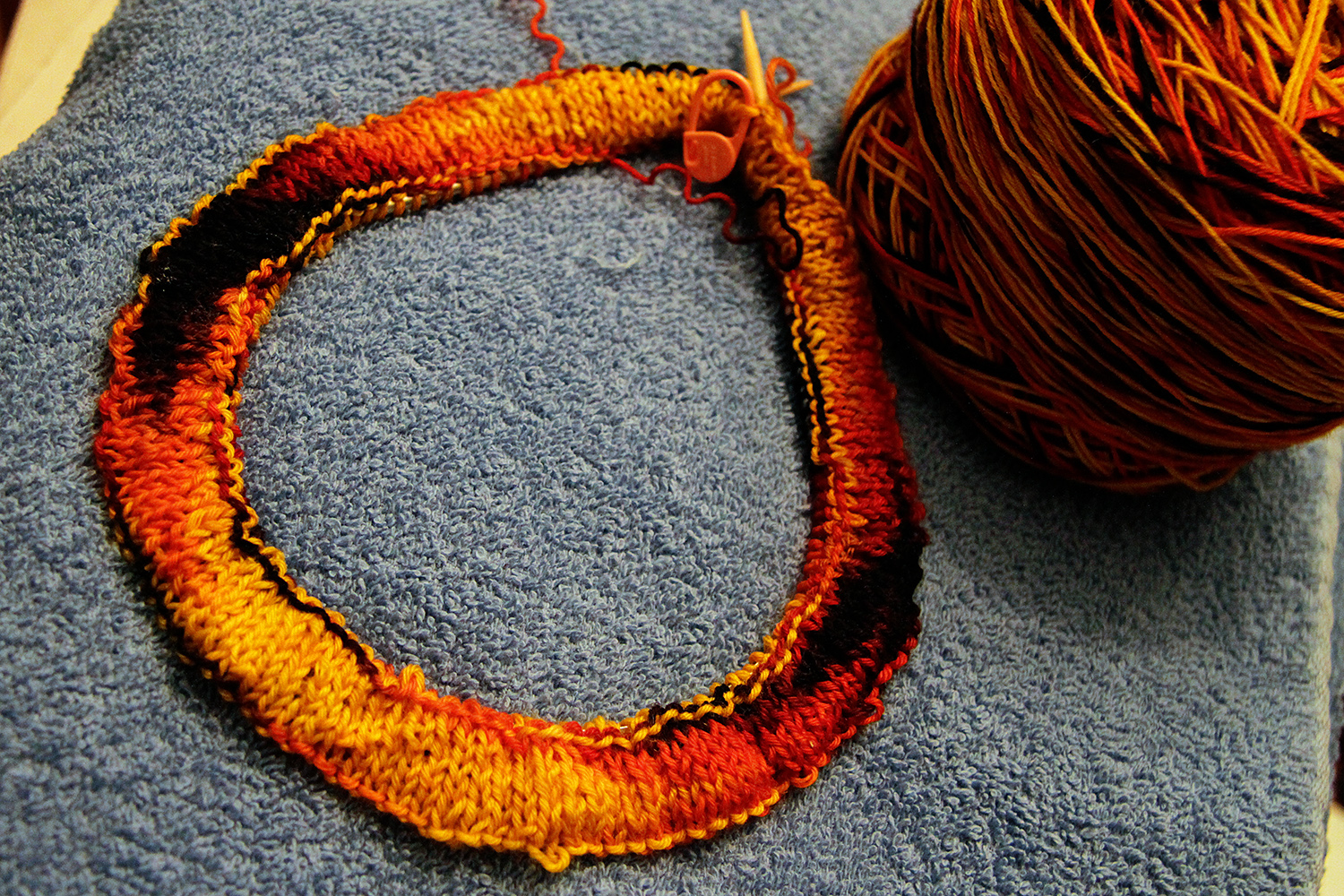
Needlework Tuesday - Sky Scarf Done!

My sky scarf is done! YAY! I can't believe it's been a whole year since I started it. Today I knitted the final two rows. I still need to weave in some ends, but it's off the needles.

I actually had mixed emotions about casting off and cutting the strands to secure the last stitch. On one hand it was nice to be done.  One the other, this piece was on the needles for a relatively long time. It was a little sad to see it end. 

It's by no means perfect. I know I knitted at least one day twice and somehow I ended up with two extra stitches (started with 50, ended with 52). That's not really surprising because I was knitting with two strands of yarn; it was easy to split them or drop one occasionally, which I also did. I corrected some mistakes as I went along, but mostly I didn't notice. Knitting in front of the TV can be distracting.

Anyway, here's the finished scarf:

Sky Scarf I

Here's all of the leftover yarn:

Leftovers

Quite a bit, eh? Two of the skeins (dark blue and white) are the second ones of that colour.  I'm still working off the first skein of all of the others.   

Since I have lots of yarn leftover, I think I might make another one. Crazy, right? I think it'll be cool to compare the two. If I make it narrower, I should have enough to make it through a whole year. Since the yarn is a tad pricey, I'd really like to use it up and not purchase anymore. Also, I'm going to rethink my choices for certain weather/sky conditions. I'd like to be able to tell overcast from light rain (currently both are white and light grey) as well I'd like to be able represent freezing rain somehow (thanks for mentioning this Heather). Because of these changes, I won't be able to compare the years exactly, but it'll be close enough.

Also, as you can tell better here, a few of the colours, namely the light blue and dark grey, were barely used at all:

Sky Scarf II

I'd like to make more use of them. I'm not sure how yet.

Anyway, I'm going to start recording the sky conditions tomorrow. If I decide that I'm going to make another one for the coming year for sure, both scarves will represent May 1 to April 30. At least that'll be consistent.

I'm still thinking of making a temperature scarf (hosted by Bernat), but I'm stalled at picking the yarn. Heather over at Books and Quilts offered a suggestion as to which yarn I could use, but I'm still waffling. I love her suggestion, but I'm a little worried that the yarn will be too thick to carry the stragglers up the side. If it is, I'll have to cut and rejoin the colours as needed. Can you imagine how many ends that'll leave to weave in? OMG!  I'm going to look into it further.  I plan to (hope to) use historical data for this one so timing isn't critical, but I really want to stop talking about it and start knitting soon. 

By the way, as I post this our rain has turned into snow, flurries for now. According to the forecast , it's supposed to snow overnight and all day tomorrow. *big sigh*. So far, it doesn't look like we'll get as much as the western and northern parts of the province.  5cms instead of 15-20cms.  *fingers crossed* A lot of our winter snow pack melted over the past few days because of some (finally!!!!) warm temperatures, however, it's really hard to tell that it's the end of April. It looks and feels like early March.    Mother Natures needs a smack up side the head!

Needlework Tuesday is hosted by Heather over at Books and Quilts. Tami over at Just One More Thing... is doing some wonderful quilting. Be sure to visit both of them to see what they've been up to.

Monday, April 29, 2013

Need You Now by James Grippando

In Need You Now, Abe Cushman commits suicide after pulling off a 60 billion dollar Ponzi scheme. Patrick Lloyd's girlfriend Lilly is somehow tied to the lost millions which puts both of their lives in danger. They hope they can remain on the run long enough to uncover the truth and evade the powerful people determined to keep their secrets.

I have mixed feelings about this book. I liked the premise, which played on the notoriety of Bernice Madoff. It probably would have been thrilling if I could have followed it all the way through. There was just too much going on. I have a vague idea about money laundering and Ponzi schemes. The people who set up these things make it hard to follow on purpose. However, with this one, it was almost impossible. It just seemed overly complicated with way too many people involved.

I like it when the author periodically goes over what's known so far in the mystery. That allows me to review what I've already learned, remember what I've forgotten and catch up if I missed anything. That's especially important with complicated plots like this. In my opinion, Grippando doesn't do that enough. At least, he doesn't do it clearly enough for me. I followed some of it, but I got lost many times and had to go back and reread some sections.

Having said all of that, I did find a couple of bright spots. I loved Evan the computer guy or "quant" as they called him. He was awesome, quirky and into computer stuff. I liked that. I also really liked the parts where Andie, the FBI agent, was trying to decipher Evan's research that was up on his walls. It was a little hard to follow (a diagram might have helped), but it was no worse than other parts of the book that I couldn't follow at all.

New Words:
quant (used in a couple of places): an expert in quantitative data.
hawalas (page 280) According Wikipedia, it's Arabic for "transfer". I didn't really understand the concept, but it looks like a way to transfer money outside of regular banking channels. If you are really interested and want to can read it for yourself, click here.

Apparently, the book title was taken from a song from Lady Antebellum called Need You Now. I wasn't familiar with it, so I looked it up on Youtube and listened to it. I'm not sure what it has to do with the story, but it's a pretty catchy tune.

I've read a couple of Grippando's books now and seem to come up with some of the same issues. Here are my other reviews: Afraid of the Dark and Lying with Strangers. The second one is a very early review that's mostly just a bunch of jumbled sentences. Also, it contains some spoilers.

I've come to the conclusion that maybe he's not the right author for me. That's ok, though. He's written lots of books and appears to be really popular with lots of people. As for me, I have lots of other authors to read.

Other reviewers on Goodreads.com really liked the book. However, even with a few bright spots, overall it didn't do it for me.

For more information about this book or to browse inside, please visit the HarperCollins website.

For more about the author and his other books, please visit James Grippando's website.

I'd like to thank those nice people at HarperCollins for this review copy.

Need You Now by James Grippando, Harper (HarperCollins), ©2012. ISBN 9780061840302(Uncorrected proof), 357p.

Tuesday, April 23, 2013

Birds of Western Canada by DK Publishing

For Earth Day, Dorling Kindersley (DK) is celebrating all the good things that come from the Earth or live on the Earth by offering some discounts on books in its Earthly Pleasures boutique.


Birds of Western Canada covers over 390 species of birds that inhabit the region. The book offers photographs and detailed information on each of the birds as well as an introduction about birds in general.

I loved this book! It's a perfect field guide for birds in my area. The information is presented in a easy-to-read format with lots of interesting details and photographs. The most common birds are presented on a full page while the rare ones are grouped four to a page.

Each full page spread features the following bits of information:
• scientific classifications: order, family and species
• several labelled photographs/illustrations showing the bird in flight and various colour forms
• small photograph of the bird in its habitat or displaying typical behaviour
• graphic of the flight pattern
• description, voice, nesting and feeding
• similar species
• maps showing the occurrence in North America
• table noting different characteristics such as size (length, wingspan, and weight), social behaviours, lifespan, and status

Each full page also has a space for the birdwatcher to record the date, time and location of a sighting. I really liked this feature. I'm forever forgetting when and where I've seen certain birds. There's only space for writing in a sighting. However, that's ok because I'll probably only want to record the first sighting.

I have a couple of other field guides for identifying birds. The one for birds in North America has too many birds that I'll probably never see. The one for birds in Manitoba (my province) has many of the birds that visit the province, however, more rare sightings or colour variations are not always represented. This book has more information than the others and seems to be the best of the bunch.

One piece of information in this book that's new to me, is the lifespan of the different birds. While some are relatively short-lived (2-3 years), others live longer, 5-15 years, and some longer still, 25+ years. There's even one (Northern Fulmar, a seabird) who lives up to 50 years. I had no clue that some birds could live so long. Very cool!

The book also includes a table of contents, glossary, and index. Both the table of contents and glossary are adequate, however, the index is too short and is missing some entries, in my opinion. For example, you can look up "Grouse" and find a list of all of the grouses. If you happen to know a specific species, you can also look it up by its full name, like "Ruffed Grouse". However, for birds like the California Quail, Gray Partridge and Ring-necked Pheasant, where there's only one type, the index only lists them once under their full name. That is, there's no entry for "quail", "partridge", or "pheasant".

Highly recommended. This book is going to be one of the most well-used reference books in our house. It's a must have for birders in Western Canada.

For more information about this book or to browse inside, please visit DK's website.

I'd like to thank those nice people at DK Canada for this review copy.

Birds of Western Canada by DK, Dorling Kindersley (DK), ©2013. ISBN 9781553631941(Softcover), 439p.

Natural History by DK Publishing

For Earth Day, Dorling Kindersley (DK) is celebrating all the good things that come from the Earth or live on the Earth by offering some discounts on books in its Earthly Pleasures boutique.


Natural History: The Visual Guide to Everything on Earth presents "a unique record of the rich diversity of life on Earth." It displays over 5000 full colour entries from rocks and minerals to plants, animals and microscopic life forms. The book also highlights a number of individual specimens and species allowing the reader to get a closer look at their splendor.

This is such a fantastic book. It's large format allow for lots of gorgeous labelled photographs and tons of information on the various living organisms. It's amazing how many different specimens are represented. I love being able to get up close to organisms that I wouldn't normally see (species from other continents) and/or ones that I'd rather not see up close (i.e. snakes).

The introduction starts off with explanations about the Earth in general, evolution, human impact and traditional scientific classifications. The most interesting part of this section is the "tree of life", which shows how all of the living organisms are related.

After the introduction, the book splits off into 5 sections: mineral and rocks; microscopic life; plants; fungi; and animals. My favourite parts into these sections are the feature profiles which examine a single species from all angles. For example, the white rhinoceros is photographed from the front, rear and side as well as in a relaxed pose showing most of his head and body. There are also close-up shots of his eye, ear, mouth, horn, hide, foot and tail. In addition to the photographs, there's also some general information and a table with size, habitat and diet listed.

While reading the book, I came across an animal that I had seen in our yard a few years ago, but didn't know what it was. This book allowed me to finally identify it. I had mistakenly identified it as a pine marten, but after seeing a great photograph in this book, I now know it was a fisher.

I was also able to identify one of the many mushrooms we had growing in our lawn a few years ago. It's a lawyer's wig. I remember it vividly because I had photographed it a number of times during the day as it matured and changed.

The book also includes a table of contents, glossary and extensive index.

Highly recommended. This book is going to get lots of use in our household.

For more information about this book or to browse inside, please visit DK's website.

I'd like to thank those nice people at DK Canada for this review copy.

Natural History by DK, Dorling Kindersley (DK), ©2010. ISBN 9780756667528 (Hardcover), 648p.